Atlas · Current build
Gas Town
An open-source toolkit for orchestrating AI coding agents, built atop the Beads ledger. Shipped at v1.0 in 2026. The community hub is gastownhall.ai.
What it is
Gas Town is the toolkit I built to run my own coding-agent work, open-sourced on Jan 1st 2026. Gas Town is an early example of a "Dark Factory," a system where agents work together autonomously in the background.
Gas Town solves the hard problems that we faced with coding agents in 2025: durable memory, handoffs between sessions, parallel agents that don't step on each other, a clean record of what got done and what didn't. Gas Town is a cohesive set of moving parts that can run dozens of parallel agents, with purpose and oversight. Gas City takes it a step farther, splitting Gas Town into its component parts, reusable in an SDK for building your own orchestrators. Gas City can run hundreds of concurrent agents and can handle large enterprise AI automation scenarios.
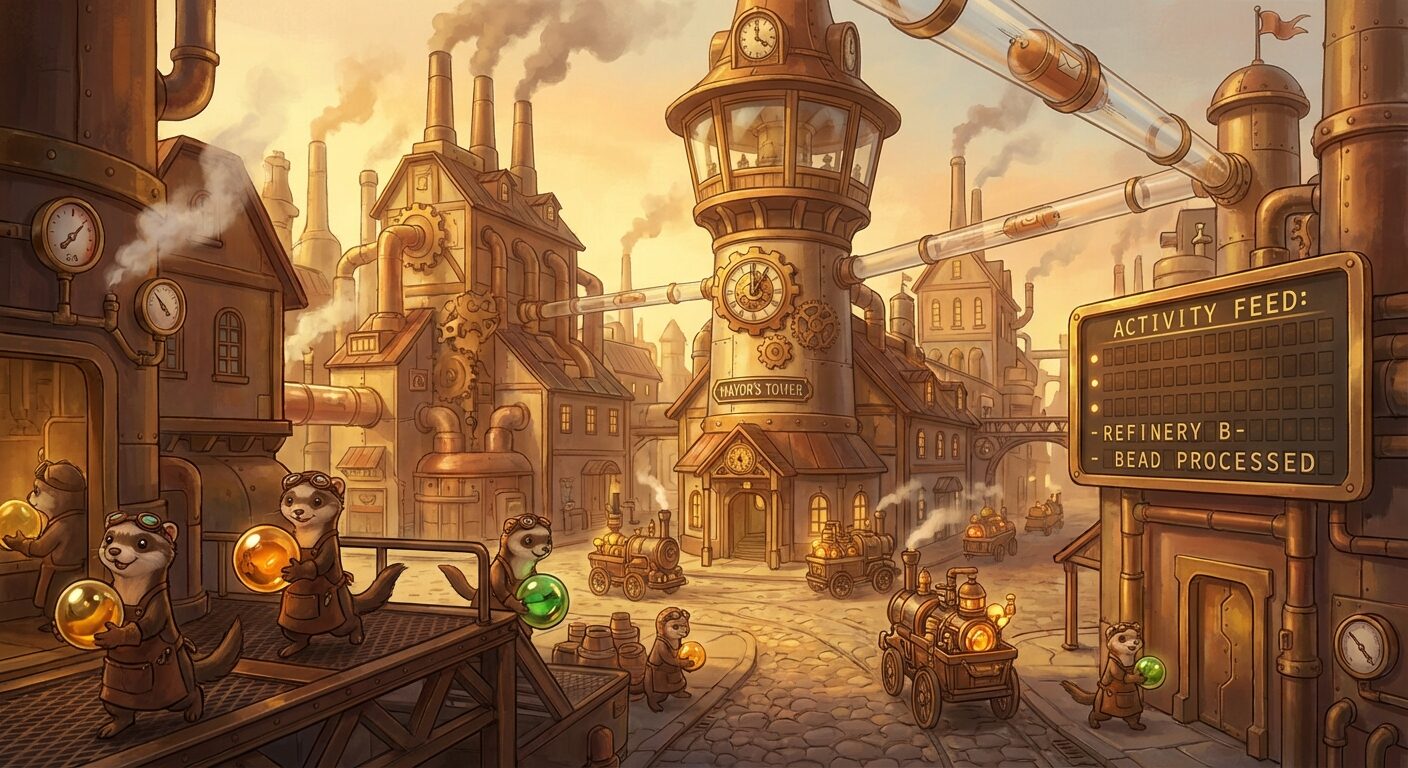
I borrowed vocabulary from Mad Max in part for the theatricality, which helped establish Gas Town firmly as a 2026 cultural meme. But also in part because the names map well to Gas Town's Kubernetes-like orchestration shape: Polecats are workers, refineries serialize merges, a witness watches each rig, a mayor coordinates across rigs. "Cook a formula, sling it to a polecat, the witness watches, refinery merges." Naming the parts the way a mechanic would makes the system legible — both to the humans running it and to the agents working inside it.
Beads — the foundation
Beads is is a portable work ledger. It can be used by itself, as a powerful tool for enhancing agent memory and building your own orchestrators. Beads is like adderall for your coding agent: it will keep the agent focused, no matter how many tasks you throw at it. At 23k GitHub stars and climbing, Beads has been a sensation.
The Beads ledger powers the Gas Town ecosystem (including the Wasteland and Gas City). In Beads, each unit of work — a task, a fix, a merge request, an agent's note to itself — is a bead, stored in a version-controlled database that's audit-trailed, queryable, and durable across sessions. Agents read and write the ledger; humans audit it. When a session crashes or hands off mid-task, the next session reads the beads and continues from there.
Beads predates everything else in the project — it shipped in October 2025, three months before Gas Town. Gas Town is one thing built on top of it; Gas City, the next-generation declarative orchestration toolkit, is another; the Wasteland federates Gas Towns over the same ledger. Beads is the common floor.
It also stands alone. Plenty of people pick up Beads just for the memory and persistence story without ever running Gas Town — it's the most-starred part of the project. Repository: github.com/gastownhall/beads.
The Wasteland
Launched in March 2026, the Wasteland is what happens when you link Gas Towns together. It's a shared wanted board: post work that needs doing, claim work other people have posted, earn stamps from validators when you finish it. Stamps are multi-dimensional — quality, reliability, creativity — not just pass/fail. Over time they add up to a character sheet: a profile derived from real work, not self-reported.
Reputation in the Wasteland is portable. You can fork the commons, run your own wasteland, and take your stamps with you. The community hub is gastownhall.ai.
Writing
Beads series
-
2025-10
Introducing Beads: A coding agent memory system
The opening post. Why a coding agent needs durable memory, and what Beads does about it.
-
2025-10
The Beads Revolution: How I Built The TODO System That AI Agents Actually Want to Use
The longer write-up. Beads as a TODO system designed for agents, not humans.
-
2025-10
Beads for Blobfish
A walk-through, written as a tutorial.
-
2025-11
Beads Blows Up
Three-week status update — spreading fast, brutally buggy, core holding. Introduces "Landing the Plane," one prompt that runs all the end-of-session hygiene.
-
2025-11
Beads Best Practices
Patterns from real use.
-
2026-03
Vibe Maintainer
On maintaining a fast-growing open-source project in the agent era.


Gas Town series
-
2026-01
Welcome to Gas Town
The introduction. What Gas Town is, why the vocabulary, and why multi-agent workspaces are the next interface.
-
2026-01
The Future of Coding Agents
Where the coding-agent stack is going and why durable memory plus parallelism win.
-
2026-01
Gas Town Emergency User Manual
A practitioner's guide. What to do when the rig is on fire — written for the people actually running this.
-
2026-03
Welcome to the Wasteland: A Thousand Gas Towns
The federation pitch. What links Gas Towns into a wider commons, and why portable reputation matters.
-
2026-04
Gas Town: From Clown Show to v1.0
The path from "this barely works" to v1.0 — the failure modes along the way and what eventually held.
-
2026-04
Welcome to Gas City
A next-generation orchestration toolkit, built on the same Beads ledger.


Talks & demos
Conference
-
2025

Beyond Instructions: How Beads Lets AI Agents Build Like Engineers
AI Tinkerers — the case for durable memory as the missing piece of agentic coding.
Live demos
-
2025

Gas Town Refinery #1 — Steve uses Jane Austen to run Gas Town
Hosted by Chris Sells. Live demo of Gas Town in actual use — Steve at the wheel, narrating decisions as he makes them.
Podcasts
-
2026-02

Gas Town, Beads, and the Rise of Agentic Development
SE Daily · Kevin Ball. Long-form conversation on what changed and what's next.
-
2026-02
Gas Town, Claude, and the Rise of AI Factories
Intelligent Machines #856 · TWiT · Leo Laporte, Jeff Jarvis & Paris Martineau. What multi-agent workspaces look like at scale.

A small lexicon
Eight words covering most of the moving parts.
- Bead
- A unit of work. Atomic, durable, version-controlled.
- Formula
- A template for a piece of work — the recipe a polecat cooks.
- Polecat
- A worker agent. Persistent identity, ephemeral sessions.
- Witness
- The patrol agent that watches the polecats on a rig.
- Refinery
- The merge-queue processor. Serializes merges so nothing collides.
- Mayor
- The chief-of-staff agent. Coordinates work across rigs.
- Wanted board
- The Wasteland's posted work — claimable by any Gas Town.
- Stamp
- A multi-dimensional attestation on completed work.
Gas Town and Beads are MIT-licensed and live on GitHub at gastownhall/gastown and gastownhall/beads. The community is at gastownhall.ai.