
Steve Yegge
Engineer and writer. Forty years in software — Amazon, Google, Grab, Sourcegraph.
Now advising engineering organizations on AI transformation.
For organizers & press
Drop-in bio.
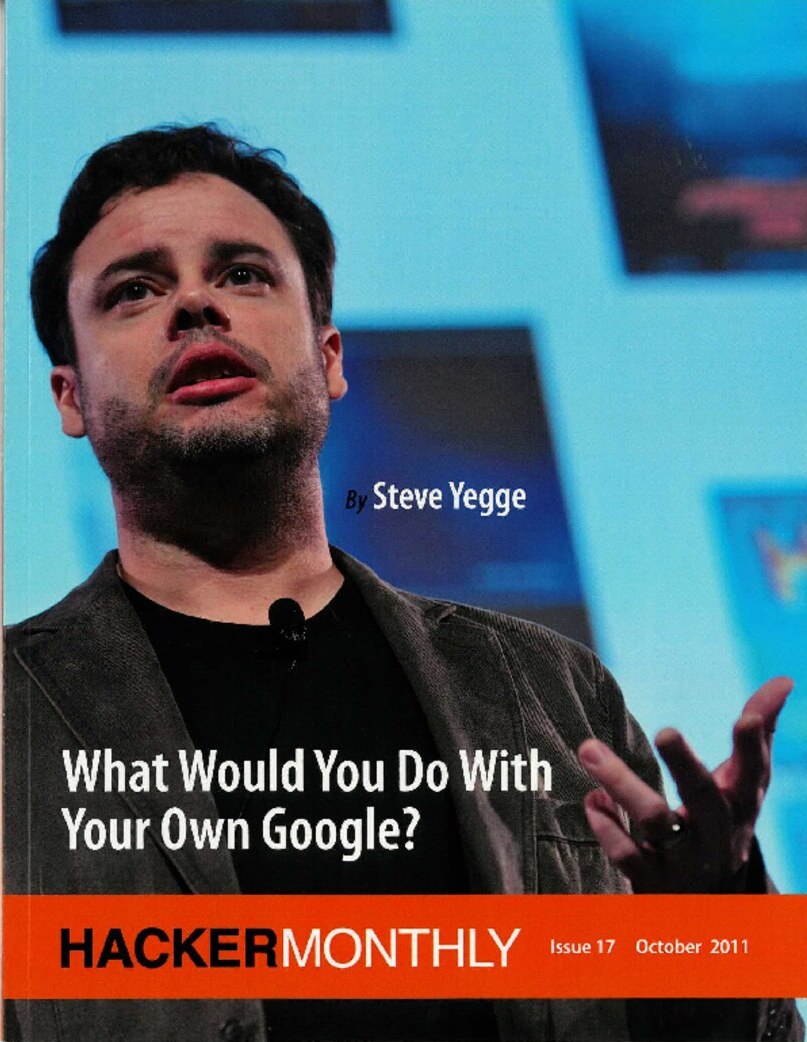
For speaker lineups, event programs, and announcements. Copy whichever length fits; a headshot is below.
Short · ~100 words
Steve Yegge has spent forty years in software, from 8086 assembly at Geoworks to Amazon (1998–2005) and Google (2005–2017), where he built the internal code-search system Grok and wrote the accidentally-public 2011 “Platforms Rant” — still among the most-cited pieces on platform thinking. He led engineering for Grab’s advertising business across Southeast Asia, then headed engineering for Sourcegraph’s AI coding assistant, Cody. He is co-author, with Gene Kim, of Vibe Coding (IT Revolution, 2025), and has written Stevey’s Blog Rants, read and argued over by programmers for two decades. He now advises engineering organizations on AI transformation.
One line
Steve Yegge is a software engineer and writer of forty years — Amazon, Google, Grab, Sourcegraph — co-author of Vibe Coding, now advising engineering organizations on AI transformation.

This is Steve's career bio; for the personal side, see his personal page.
Steve Yegge has spent forty years in the engine room of the software industry. He began without high-level languages at all — half a decade writing 8086 assembly at Geoworks — which may explain why he found them so easy to give up again when AI arrived.
Then came nearly two decades at Amazon and Google. At Amazon (1998–2005) he led teams and programs across Customer Service technology and Developer Tools during the formative years of the company's engineering culture. At Google (2005–2017) he created Grok, the company's internal code knowledge graph, and wrote an internal memo in 2011 that accidentally became public and turned into the most widely cited piece on platform thinking in the industry.
At Grab (2017–2020) he was Head of Engineering for Ads & Data Monetisation in Southeast Asia, operating at enormous scale across eight countries with radically different infrastructural, cultural, and regulatory realities — and learning, first-hand, how Silicon Valley's value system fails abroad and how foundational relationships carry where it doesn't. After a year spent resurrecting his game Wyvern and moving it to the cloud, he joined Sourcegraph (2022–2025) as Head of Engineering — a natural fit, since Sourcegraph was inspired by the Google Code Search that grew out of Grok. Eighteen months in he stepped back to an IC role to focus on AI; the prediction that became Death of the Junior Developer followed shortly after.
Across all of it he has been writing. Stevey's Blog Rants began at Amazon's internal developers' journal and ran for roughly twenty years — widely read, frequently argued with, and, at its best, genuinely funny. He is the co-author, with Gene Kim, of Vibe Coding (IT Revolution, 2025). Since late 2025 he has been independent, building the multi-agent orchestration system Gas Town.
The through-line of the consulting practice is simple: nearly every company he talks to is blocked not by the technology but by its own culture. That — moving an engineering organization through the cultural shift to working AI-native — is the work. See the services, or the coverage and impact of the writing it draws on.
Career
Where he's been.
The full history — Geoworks, Amazon, Google, Grab, Sourcegraph, the Navy, and the schools before all of it — lives on a separate page.
Read the history →Reception
What the work did.
Where the writing landed — in the press, on university syllabi, in the reply essays it provoked, and in the tools and reading lists built on it.
Coverage & impact →Elsewhere
Pages on other people’s servers.
Where he’s described