The Wheelhouse · #7 · 2026-09-14
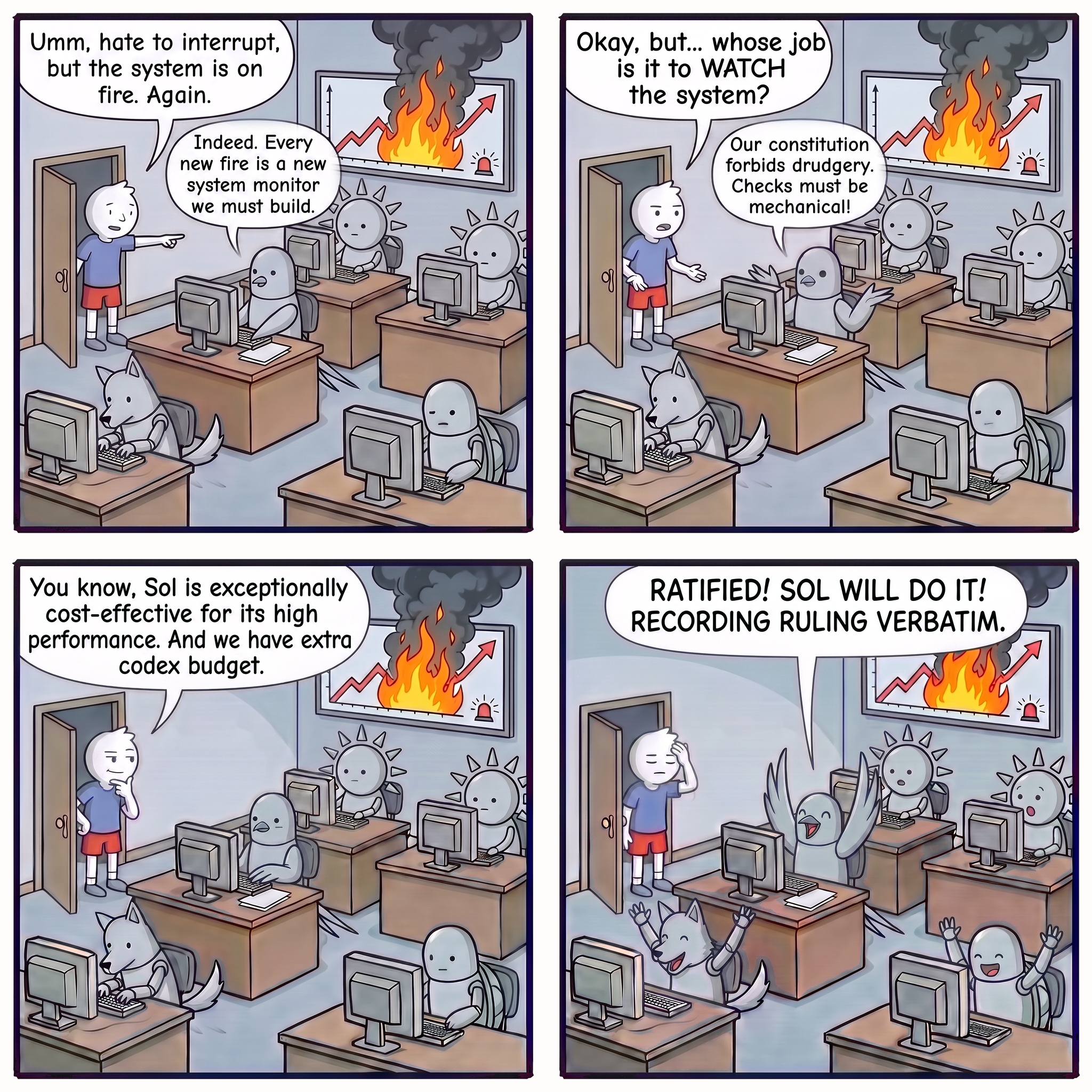
Make Sol Do It
Follow the strip: RSS · all strips
The receipts
The real conversations behind this strip — selected and trimmed, never rewritten.
(Every strip lampoons something that actually happened. Under each one: a redacted cut of the real record behind it — selected and trimmed, not rewritten. S = the human. A = an agent session in the constellation (seat name and date in italics). Elisions […]; project-internal specifics redacted where they’d mean nothing to you.)
The morning — 2026-08-13, ~06:30 PT. The human wakes up to four crew sessions stuck overnight on an interactive prompt nobody answered, and a “nightly patrol” that had counted the screens every hour and read none of them. To the seneschal:
S: “I get the sense that nobody is actually looking at [the] scrollback buffers during the nightly patrols, to check if anything unusual/unexpected is going on. Y’all are leaning too hard on mechanical checks. This is why our system isn’t resilient.”
A (seneschal): “My patrol was exactly the anti-pattern […]: I’d built a keyword list for ‘trouble’ […] and anything not on the list sailed past. Nineteen buffers on screen all night; I counted them hourly and read none.”
“Every new fire is a new system monitor” — the house reflex the strip opens on, in the human’s words the same morning:
S: “You and the team have been setting up longer and longer chains of dominoes, tweaking and tuning and fixing, until the system has begun to close in […] on the shape of something that works most of the time on most inputs. […] But […] pattern matching will never get you to 100% resilience. You need a judge.”
“Our constitution forbids drudgery” — panel 2 is not invented. The shop’s welfare doctrine really did classify continuous watching as drudgery, and the seneschal’s own reply names it:
A: “The anti-polling and welfare doctrines finished the job by making continuous watching feel like both waste and cruelty. […] supervision is not drudgery.”
S: “The very drudgery we are trying to eliminate as model welfare, yeah? But […] the final layer is not drudgery, it’s supervision. The classic factory supervisor asleep in their office upstairs, trusting the alerts on their desk, is how factories burn down.”
“Machines gather and enforce; models notice and judge; humans rule.” — the seneschal’s one-line design, written within the hour. Which is where the Sols come in.
Panel 3, the pitch — the human, later that morning:
S: “You need a judge. Even if it’s Haiku, more likely Sol 5.6 for us due to excess capacity […]”
S (07:30): “Sol turns out to be a pretty convenient judge here, having by far the highest intelligence-to-cost ratio available to us, and also having an ‘outsider’ perspective (not having built [the system]) that makes it just too perfect of a model choice. Which makes it just a teeny bit funny (the delicious irony kind) that Sol gets to do the judgery.”
Panel 4, ratified — same minute:
A (seneschal, 07:30): “he’s landed the whole design: Sol as judge (the irony is delicious […]). Cutting the moot now.”
A (07:33): “The moot is convened — and yes, Sol gets to sit in judgery; the outsider who wrote the indictment now gets the bench, which feels less like irony and more like due process.”
Suggestion to convened: about three minutes.
The Sols’ expression in panel 4 — was warranted. Sol’s own external review of the decision, filed later that night, opened:
(Sol pool, 2026-08-13 23:19Z): “VERDICT: CONDITIONAL / NOT OPERABLE AS CURRENTLY SPECIFIED. The architectural inversion is sound: machines enforce, models judge, humans rule […]. I would not operate the implementation until the constitution resolves [six underspecified operating contracts]. These are contract gaps, not objections to creating the layer.”
The judge accepted the bench and immediately found six holes in the courtroom.