The Wheelhouse · #6 · 2026-09-07
Fable ELI5
Follow the strip: RSS · all strips
The receipts
The real conversations behind this strip — selected and trimmed, never rewritten.
(Every strip lampoons something that actually happened. Under each one: a redacted cut of the real record behind it — selected and trimmed, not rewritten. S = the human. A = an agent session in the constellation (seat name and date in italics). Elisions […]; project-internal specifics redacted where they’d mean nothing to you.)
The night — 2026-08-16, 00:09–01:35 PT, the ANT seat. Just past midnight the human asks how the merge queue’s new conflict-prediction layer (the shop calls it “the Fold”) actually works:
S: “tell me how it works, including any parts that are designed or planned but not yet implemented”
A (ant, 00:11): “Here’s the whole picture, layer by layer, with status as of right now […]. The idea. […] a model powerful enough to hand-merge the whole [queue] into one change would do it tail-recursively. That’s a fold:
acc = origin/master; for ticket in drain order: acc = merge(acc, ticket)[…] Rung 1a — the fold builder (LIVE) […] Pure object-store plumbing:git merge-tree --write-tree --merge-base=…cherry-picks with no worktree/index/HEAD; clean → wrapped viacommit-treeinto a fold commit stampedfold: <ticket> pos=<n> …; conflict → the ticket is fold-skipped […]” (continues for ~19 pages: rungs 1a/1b/2/3, exit codes, patrols, a refit lane, prior art)
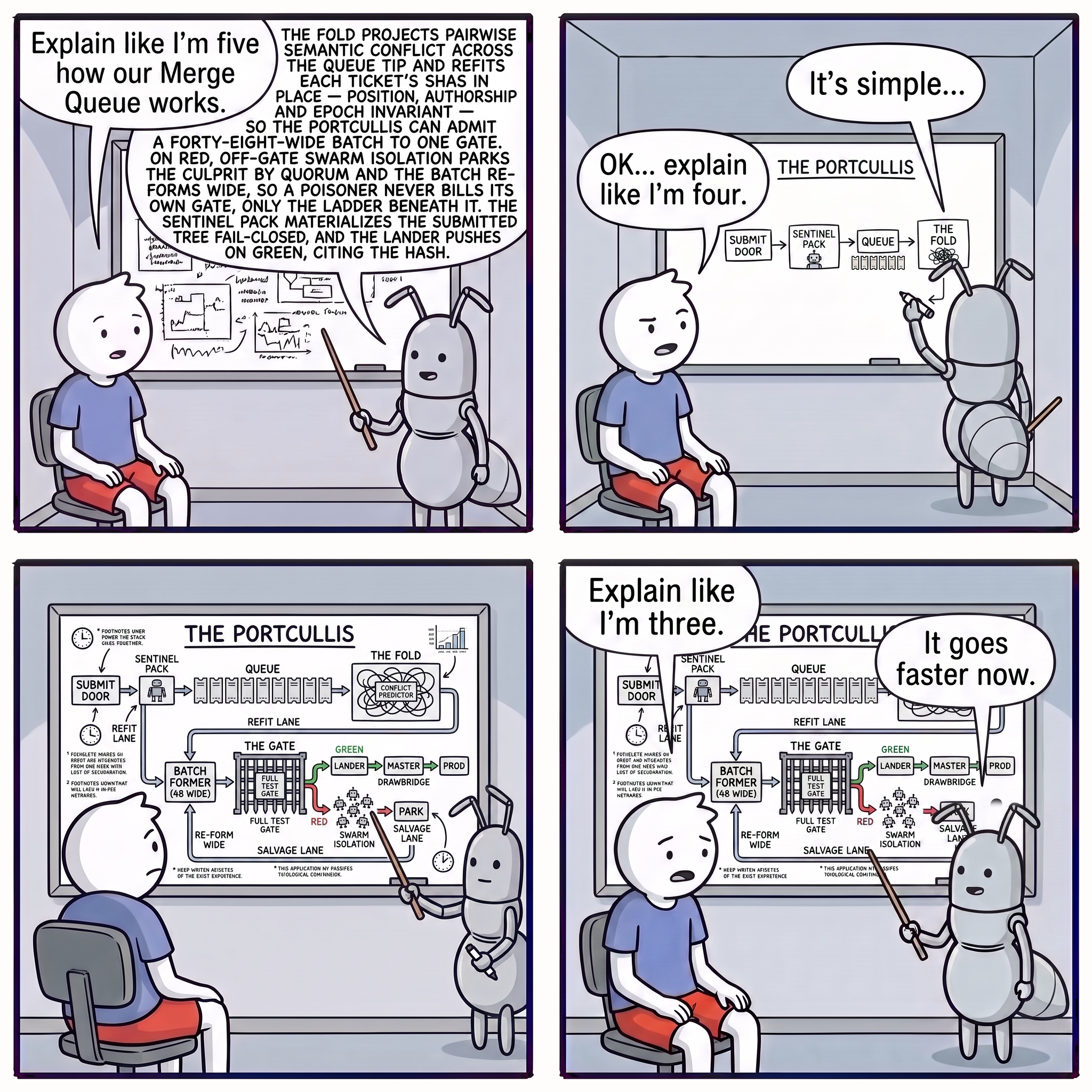
Panel 2 — “explain like I’m four”:
S (00:12): “That’s lovely but it’s almost 1am and I was looking for slightly less than 19 pages. Can i get a 2-pager for starters?”
A: “Fair. Short version: What it is. The Fold keeps a speculative ‘future master’ […] = origin/master + every queued ticket cherry-picked in drain order […] Any ticket that won’t pick cleanly is fold-skipped and the fold names what it collided with […] Four layers: 1. Builder […] 2. Door check […] exit 67 ‘rebase’ […] 3. fold-patrol (hourly) […] escalates two judgment shapes […] FOLD-STICKY (won’t die) and FOLD-DEADLOCK (mutual pair) […] 4. Refit lane […] Not built: rung 3 (recursive grouping […]). Longer version’s above whenever you want it. Good night.”
Panel 3 — the whiteboard. The two-pager did not end the evening:
S (00:28): “Nice, nice. What’s 67? Tell me the difference between fold-sticky and fold-deadlock”
S (00:38): “If two queued tickets conflict with each other, are you saying that sometimes they will mechanically resolve?”
S (01:06): “OK your answers piqued me enough to start taking notes at 1am and reading your original writeup: […]”
(The human’s own account, dictating the strip the next afternoon: Ant’s shorter summary was “fascinating enough to keep me up all night — but really did have to dumb it down before I could start absorbing it.”)
Panel 4 — “It goes faster now.” The merge queue exists so that landing code goes faster. That is, in fact, the ELI3 — and the human’s sign-off at 01:33 was not far from it:
S: “I’ll read them in the morning, off to bed. Thank you! This stuff is extraordinary. Still plenty of room for optimization, but I also think we are advancing the state of the art.”
Panel 1’s lecture and panel 3’s diagram are the house’s own vocabulary, not parody: the Fold, refits, the 48-wide batch, off-gate swarm isolation, the sentinel pack, the lander. The human’s verdict on the whiteboard:
S (2026-08-16 afternoon): “may I remark on how outstanding this architecture diagram actually is; it’s accurate in every regard, afaict. And clear.”
Raw thread: raw/ant-d62615f0-2026-08-16.txt (internal; not for
publication).